
June 11, 2026
Advancing employability, economic resilience and environmental responsibility in the Kurdistan region of Iraq (KRI) and Yemeni Universities
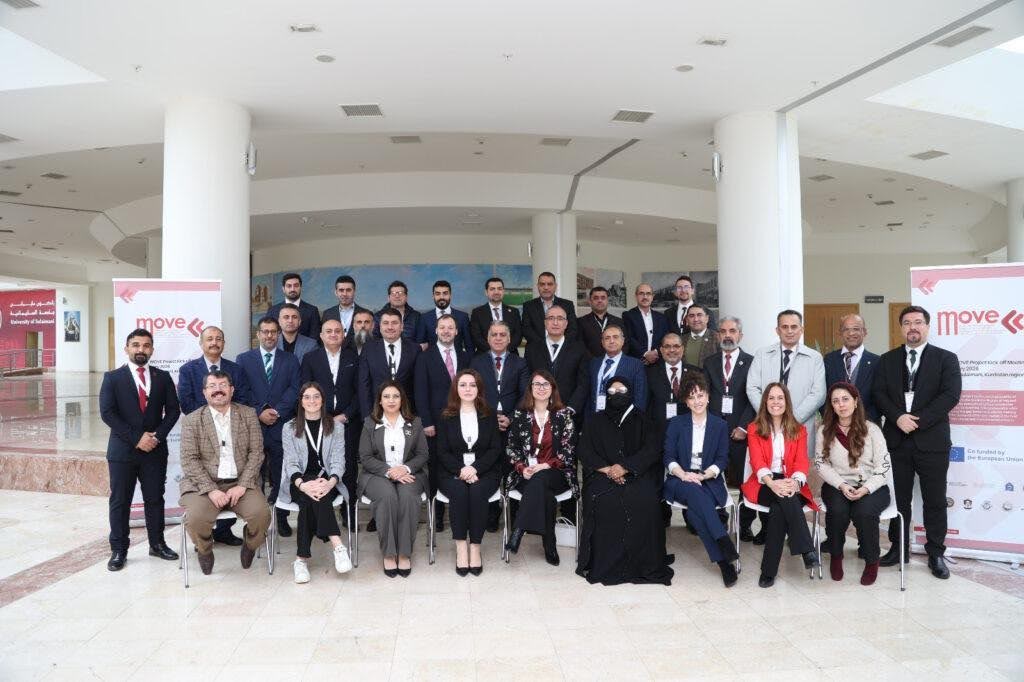
On 14 and 15 February 2026, the University of Sulaimani, in Sulaymaniah, in the Kurdistan region of Iraq hosted the Kick-off Meeting of the MOVE project – enhancing university graduates’ employability through skills development and industry collaboration, a three-years EU funded project within the Erasmus+ programme under the Capacity Building for higher education action. The MOVE project tackles unemployability of graduates in the Kurdistan Region of Iraq and Yemen by strengthening local universities capacities and fostering entrepreneurship while bridging the gap between academic training and the demands of the job market in the field of agriculture and environmental sciences. The MOVE project, led by UNIMED, includes: Salahaddin University – Erbil,the University of Duhok, the University of Garmian, the University of Sulaimani, along with the Yemeni partners, the University of Aden and the University of Hadhramout, and 2 European universities, the University of Calabria and University of Murcia, and the collaboration of two socio-economics partners, the Kurdistan Agricultural Engineering Syndicate and the Selah Foundation for Development from Yemen.
The two-day event featured dialogue and exchange sessions between all the partners and marked the official launch of the project designed to bridge the gap between higher education and the labour market in the Kurdistan Region of Iraq (KRI) and Yemen. MOVE will connect universities, specifically faculties in the agricultural and environmental sciences, and the private sector to support skills development, foster stronger university–industry links, and help graduates access better opportunities in the labour market.
Official Launch of the Project
The event opened with welcoming remarks by Shirwan Hamasalh Omar, Vice-President for Student Affairs at the University of Sulaimani, who highlighted how the event represented not only the launch of a project, but also a meaningful opportunity to strengthen cooperation between universities and industry in two different economic and social contexts which are the KRI and Yemen He stressed that the true measure of success for higher education is not the number of graduates, but the quality of their skills and their ability to contribute concretely to the development of their countries.
Taking the floor, Mohammed Hussein Ahmed, Director General and Head of the Apparatus of Supervision and Quality Assurance at the Ministry of Higher Education and Scientific Research in the Kurdistan Regional Government (KRG), pointed out that higher education is currently facing a crucial moment, where the real impact of universities must be measured by graduates’ employability and their integration into the labour market. Universities must therefore move beyond traditional teaching models, ensuring the transfer of practical and transversal skills such as digital competencies, communication abilities, and teamwork.
Joining online, Tommaso Sansone, Consul General of Italy in Erbil, extended his greetings to the institutional representatives and thanked UNIMED and the University of Sulaimani for their invitation. He noted that the transition from graduation to employment represents one of the most challenging phases in young people’s lives, particularly in a context marked by social and economic uncertainty and global challenges such as climate change. Bridging the gap between education and labour market needs is therefore essential to build young generations capable of addressing real change in their communities.
Afterward, it was the turn of Radu Butum, Head of Office of the EU Delegation Erbil Liaison Office, who described the MOVE initiative as highly relevant for society, particularly as it seeks to enhance employability, an issue that still requires stronger attention in the region. In a rapidly changing world shaped by disruptive technologies, he remarked, the challenge goes beyond education alone: institutions must equip individuals with the tools and adaptability needed to thrive in a new and evolving environment. He also recalled how the MOVE project is perfectly in line with the new Pact for the Mediterranean, the flagship initiative of the European Commission, that has among the others, the objectives of creating opportunities for young people and businesses; to boost jobs creation and to strengthen education, skills and mobility across the region.
Finally, Silvia Marchionne, UNIMED Senior Project Manager and MOVE project coordinator, took the floor to state that beyond curriculum reform, MOVE seeks to drive institutional transformation, empower universities as engines of economic and social development, and build stronger connections between academia, industry, and policy. She stressed on the fact the MOVE is in line with the UNIMED’s mission which has always been to connect universities across regions, promote academic cooperation, and create platforms where shared challenges can be addressed collectively. “At the same time, one of the most valuable dimensions of this project is the South–South cooperation between the Kurdistan Region of Iraq and Yemen” said the MOVE project coordinator. “This cooperation is not about transferring models from one context to another, but it is about mutual empowerment. And it is about strengthening regional solidarity in addressing shared priorities such as sustainable development, environmental protection, and employability.”
The MOVE journey: contribution from each partner institutions
Silvia Marchionne, UNIMED Project Manager and MOVE Project Coordinator, provided an overview of the initiative, the rationale behind the project idea, the main expected outcomes and its attended impact, together with the next steps and activities to be implemented. The meeting also featured presentations from the European partners: Dr. Cesare Oliviero Rossi, Professor at the University of Calabria, along with Marina Reche Pardo – Entrepreneurship technician and Eva Pinar Moreno – Technical Specialist at the University of Murcia who shared experiences of their institutions and on how to boost an entrepreneurial mindset and employability patterns, stressing the role and responsibility of universities in supporting graduates’ skills development.
Key representatives of all local beneficiary universities from the Kurdistan region of Iraq and Yemen presented their institutions to the audience and contributed to kick-off the collaboration with their perspectives and expectations for the MOVE project. Their insights are fundamental in the implementation of the next steps of the project and its sustainability, taking into account the specific needs of the HE system and the labour market needs in the two respective countries of Kurdistan region of Iraq and Yemen.
The project aims indeed to reach these goals through a series of actions included in 5 key Work Packages. The partners will work to assess the academia-job market relations in order to align the curricula with the job market needs in the field of agricultural and environmental sciences. This will lead to the curriculum update on each of the 6 HEIs in Yemen and KRI in terms of learning outcomes, teaching and learning methodology and in terms of innovative and updated content for the curricula. Following the curriculum reform, the project will enhance skills and competences of university staff through capacity building of educators, administrative staff and students to finally promote entrepreneurial and innovative mindsets among students, focusing on the needs of society and the local market. Finally, students will participate in a green Hackathon and will have the opportunity to put in practice what they have learned as well as living labs as space of dialogue and knowledge sharing will be created in each university with the aim to address local and regional stakeholders. From a practical and operational perspective, the project will also bring a policy level perspective to raise awareness about the crucial role of education sustainable development towards a more inclusive green and sustainable future for the community in Kurdistan region of Iraq and Yemen.